Ustka Lighthouse - a Baltic Beacon Since 1892
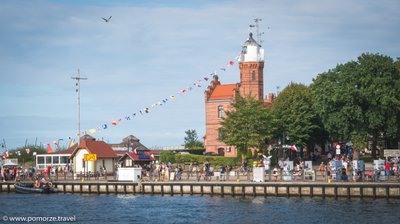
The Ustka Lighthouse is a unique historical landmark that has served sailors and tourists since 1892, combining rich history with distinctive architecture. It was built as part of a pilot station to facilitate navigation in difficult weather conditions at the entrance to the port. Its octagonal tower, standing at 19.5 meters, adjoins the brick building of the pilot station, creating a harmonious whole.
A characteristic feature of the lighthouse is its rich architectural decoration - numerous cornices, gables, and windows of various sizes. Concrete and metal stairs lead to its top, and a viewing gallery allows visitors to observe the lens system. The lighthouse light is located at a height of 22.2 meters above sea level and has a range of 18 nautical miles (approximately 33 km).
Initially, the lighthouse emitted a continuous red light, which was changed to a white, flashing light in 1904 with a characteristic pattern: 4 seconds of light and 2 seconds of darkness. Currently, the optics consist of a 1000 mm diameter cylindrical lens, and the light source is a 1000-watt bulb placed on a two-position changer.
The structure survived World War II virtually undamaged and resumed operation as the Postomino Lighthouse on November 15, 1945. However, in 1947, the historical name "Ustka" was restored. In 1993, the lighthouse was entered into the register of monuments, and since 2010 it has operated fully automatically, ending the era of lighthouse keepers in Ustka.
With its four-story structure and wealth of architectural details, the lighthouse is not only a functional navigational object but also a tourist attraction. It is an excellent vantage point from which to admire the panorama of the city, the port, and the Baltic Sea. While visiting, it is worth asking the guide about the ghost that, according to local legends, inhabits the lighthouse.