The von Below Family Palace in Sławutówko
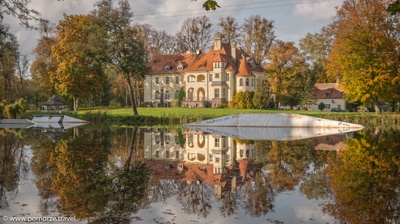
The first mention of the village dates back to 1277, when Duke Mestwin of Pomerania granted these lands to the knight Ścibor, the castellan of Puck. In the 14th and 15th centuries, the estate was owned by members of the von Slavekow family, and in 1503 it was owned by Stibor von Schlatau. In the late 16th century, Sławutówko was purchased by Ernest von Wejher, the starosta of Puck and voivode of Chełmno. From 1589 to 1676, the estate belonged almost exclusively to the Wejher family. In 1676, Wejher's daughters transferred the estate to their stepmother’s brother, Michał Kazimierz Radziwiłł, the Lithuanian sub-chancellor. In 1685, the Rzucewo-Wejher estates were transferred to King Jan III Sobieski, through a gift from his sister Katarzyna Sobieska, wife of Joachim Wolski. The monarch held these lands until 1697, and his heirs managed them until 1720. The estate was then transferred to Jerzy Piotr Przebendowski, the voivode of Livonia. In the 18th century, the estate was owned by Józef Piotr Przebendowski, his wife Urszula from the Potocki family, and their son Ignacy Franciszek Przebendowski, who, after the first partition of Poland, due to debts, sold the estate in 1782 to Alexander Gibsone, an English resident in Gdańsk. In 1796, the estate passed to his nephew, Otto Henryk Keyserlingk. After his death, the estate was divided between his daughters: Ludwika Sophie Ottilie, who married her cousin Archibald von Keyserlingk, and Emma Caroline, who in 1820 married Prussian officer Gustav Friedrich von Below. The von Below family developed a landscape park and built a mill. In 1906, the estate passed to Emma and Gustav's grandson, Gustav Karl Theodor von Below, who between 1910-1920 transformed the old hunting manor into a castle-like residence with a tower covered by a tented roof. Gustav died in 1940 and was buried in Sławutówko next to his wife, Henrietta Quistorp. During World War II, Henrietta von Below was well-liked by the local Kashubians, whom she employed. In 1945, when Soviet soldiers entered the estate, Henrietta invited them into the palace in an attempt to protect herself and her workers. However, she was shot in the garden after refusing to dance with the soldiers. Wounded, she died over the course of a week, and the locals secretly buried her next to her husband.