The Palace in Ciekocinko
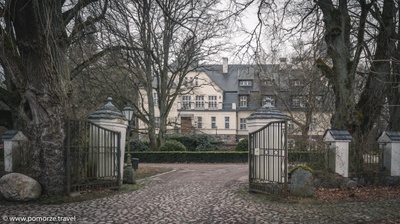
The first mention of the locality dates back to June 24, 1362, from a document in which the Gdańsk commander of the Teutonic Order, Gieselbrecht von Dudelsheim, granted the village under Chełmno law to the faithful Vicke (Wichen) and instructed him to settle the property with new tenants. For 300 years, Ciekocinko was an agricultural village. The last Pomeranian duke, Bogusław XIV, granted Matzke Borcke the localities of Zackenzin, Wittenberg (Białogóra), and Uhlingen (Ulinia) "all as belonging to the Curow estate" for his loyalty and services. Already in 1658, Zackenzin along with the mentioned villages were incorporated into the estates of the von Krockow and Osseken families. After more frequent changes of owners over the next six decades, from 1864 to 1905, it belonged to the Leo von Braunschweig family, and from 1905 to 1934, to the von Ewest family. In 1910, the Ewast family built a new, much grander palace on the site of the old manor. In 1934, the estate was purchased by the district veterinarian of Lębork, Dr. Wilhelm Koops, who was the last pre-war owner of the Ciekocinko estate.
The impressive farmstead complex consists of a palace from 1910 with an original silhouette, a grand mansard roof, and a tall, five-story tower, a steward's house, farm buildings, a distillery from the turn of the 19th and 20th centuries, and a park covering an area of 5 hectares. In recent years, a new private owner has been adapting the estate into an international equestrian center and giving it hotel functions.
One of the few musical talents from this part of Pomerania (Hinterpommern) was born in Ciekocinko: Richard Gabriel, born on September 3, 1874, died in Greiswald on May 20, 1960, an organist and choir conductor in Sagan/Schlesien (Żagań), from 1921 in Köslin (Koszalin), and from 1932 in Stettin (Szczecin); composer of works for organ and piano, ballads, singspiel, overtures, and choral songs.