The Neo-Gothic Town Hall building in Słupsk
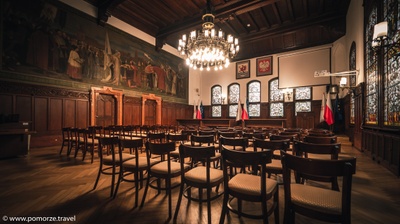
In the history of Słupsk, there have been three town halls. The oldest, dating back to the Middle Ages, had a stepped gable and a small tower on the roof, as described by Brüggemann in his 1784 work, "Exhaustive Description of the Current State of the Royal Prussian Duchies of Pomerania." It was also partially visible in the city panorama on Lubinus' 1618 map of Pomerania. At the end of the 18th century, it was replaced by a new building, which from the start was controversial for being too costly and grand for the small town. Completed in 1798, it stood in the Old Market Square. The more than century-old building was demolished after the construction of a new town hall, despite plans to repurpose it. The initiator of the new town hall was Mayor Hans Matthes. Initially, the town hall was planned for a different location, but due to marshy terrain, the current site was chosen. Previously, a pond known as "Quebbe vor dem Neuen Tor" occupied the site, which was filled in during the mid-19th century. This created Victory Square, previously known as Wollmarkt, and later Heinrich von Stephan Square, which by the late 19th century was transforming into a prestigious location. In 1910, an equestrian statue of Emperor Wilhelm I was erected there. In 1897, a competition was announced, attracting around 500 architects. The Berlin team of Karl Zaar and Rudolf Vahl won the competition. Construction began in April 1899 and was completed on July 4, 1901. The neo-Gothic town hall has served as the seat of the city government from its inception. The then-mayor of Słupsk, Hans Matthes, who held office from 1893 to 1905, spent twice the amount originally budgeted by the City Council—600,000 marks instead of the planned 300,000 marks. The new town hall was significantly larger than needed for the then-town of around 30,000 residents. Additionally, while expanding the city's infrastructure and sewer system, Matthes indebted the city by about 2 million marks. Three years after the town hall was put into use, Matthes was forced to resign amid a scandal. Despite the initial controversies surrounding the town hall’s construction, the residents of Słupsk later appreciated Hans Matthes, awarding him the title of Honorary Citizen in 1924, and naming a street after him.