The Former Carthusian Monastery Complex in Kartuzy
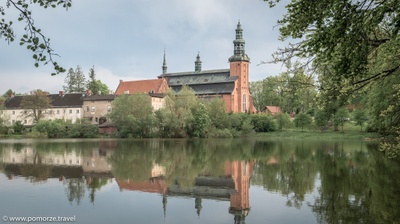
The Carthusians originate from the French Alps, where in 1084, St. Bruno of Cologne founded the first monastery. They arrived in this region in 1380 and named the newly established convent "Mary's Paradise." Within a few decades, they built a church and most of the monastic buildings, aided by the generosity of the Teutonic Grand Masters and their subordinate knights. At its peak, the Carthusian monastery owned around 6,700 hectares of land, mainly in the eastern part of today's Kartuzy County, around Kolbudy, Nowa Karczma, and Żuławy. Their holdings also included areas of present-day Gdynia, including the district of Grabówek, as well as properties in Gdańsk. One of the most interesting features of the monastery is the Gothic structure of the Church of the Assumption of the Blessed Virgin Mary, topped with an 18th-century Baroque roof, uniquely shaped like a coffin lid. Also notable are the embossed leather wall coverings in the presbytery, the only ones in Poland preserved in such quantity in their original location. The most valuable treasure is the 15th-century Gothic altar located in the side Golden Chapel. Above the main entrance to the church is a surprising symbol – a white Angel of Death, serving as the pendulum of a clock, reminding visitors of the inevitable passage of time. One of the Carthusians' mottos is "Memento mori" (Remember death). The order, whose rule has remained unchanged for 1,000 years, adheres to principles of silence, fasting, work, and spending most of the day in solitude.