St. Hyacinth’s Church in Słupsk
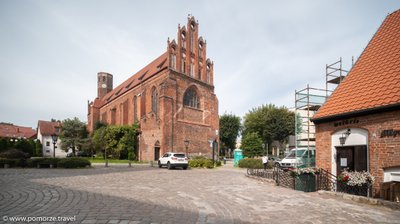
The building of St. Hyacinth’s Church dates back to the late 13th and early 14th centuries when it was constructed as a wooden temple for the Dominican order. The land for the church and monastery was donated by the Duke of Gdańsk, Mściwój II, in 1278. The Dominicans arrived in Słupsk around 1283 and began the construction of the monastery. As a preaching order, they established themselves in larger cities, reflecting the growing importance of Słupsk. Even though the region fell under Brandenburgian rule in 1307, the monastery continued to flourish, receiving numerous donations. In 1395, a great fire destroyed the wooden buildings of the church and monastery. After the fire, reconstruction began in 1395, replacing wood with red brick. The Gothic church that emerged had an extended presbytery and a seven-bay nave, which still stands today. Initially, the church had no tower, as the order's rules forbade it; the highest point was a small turret with a bell. In the 15th century, the church underwent renovations, bringing it closer to its current form. From 1505 to 1507, Duke Bogusław X ordered the construction of a nearby castle, just 50 meters from the monastery. Dominican activity in Słupsk ended in 1525 when riots, instigated by the Lutheran preacher Jan Amandus, led to the destruction of the Dominican church by an angry mob. The monks fled and never returned to Słupsk. In 1534, the church was given to treasurer Ambrosius Vormann and remained abandoned for several decades, serving as a warehouse. In 1600, Duchess Erdmutha Hohenzollern, exiled from Szczecin, undertook the church's reconstruction, converting it into a Lutheran temple and adding a pharmacy to the northern walls. New galleries, a pulpit, and a Baroque altar were installed. The church was consecrated in 1602. The Duchess died in 1623, and her epitaph, located near the altar, still adorns the church's interior. In the 17th century, the church underwent several renovations. After the death of the last member of the de Croy family, Duke Ernest Bogusław, in 1684, the church was taken over by a Calvinist Reformed congregation. In the 19th century, the building was used by both Lutheran and Calvinist communities. In 1777, the church tower was damaged, and its reconstruction gave it its current shape. A major renovation was carried out in 1875, during which the medieval northern aisle was demolished, buttresses were added, and architectural details were modified. St. Hyacinth’s Church has become a significant place not only for Słupsk's residents but also for visitors attending annual musical events such as the Organ and Chamber Music Festival, held in August. The church's organ, originally built in 1657, has been reconstructed several times, and in 2002, its original sound was restored.