Siemirowice Barrow Cemetery
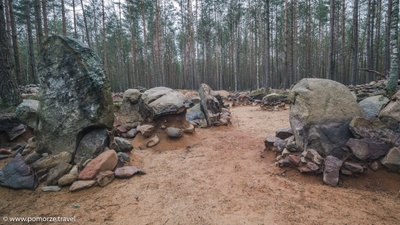
On the road leading from Siemirowice to Oskowo, in the forest, lies an ancient burial mound cemetery dating back approximately 3,000 years, used by the community of the Lusatian culture from the so-called Kashubian group. It covers an area of 1500 by 500 meters. Despite the plundering of the mounds already in the Middle Ages, they were rediscovered and examined by scientists in the 1960s. Although nominally there are 70 of them, only 10-12 heavily flattened mounds are easily discernible to the average observer. Based on anthropological research, it was established that the average lifespan of individuals buried in the cemetery was 25-35 years for women and 35-45 years for men. A large number of child burials were also identified. In many urns, the remains of several people, most often mothers with children, were deposited. Most of the mounds had a circular or similar shape in plan view, with diameters ranging from 5 to 10 meters. The largest of them had a diameter of 18 meters, and the maximum height of the mounds reached 1.5 meters. The circular shape of the mounds was achieved by arranging circles of large, tightly fitting stones at their base. Usually, single circles formed the base, inside which chests made of flat, split stones were placed. Above the chests, within the circle, a cloak of fieldstones was laid. Inside the chests were urns, clay vessels serving as receptacles, and charred human bones. They were often accompanied by metal objects, mainly jewelry, and everyday items of the deceased. The bottoms of the chests were lined with flat stones. Creating the cemetery required enormous amounts of building materials. Assuming that the average object, with a height of 1 meter and a diameter of 8 meters, required gathering 1500 cubic meters of building material.