Neogothic Church of St. Michael the Archangel in Łebunia
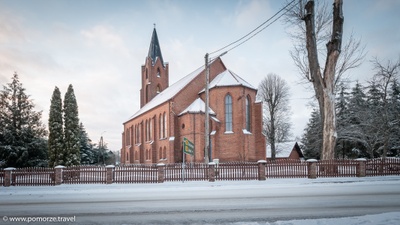
Owners of the nearby estate were guardians of the local parish, which was established as early as the 12th century. The first church in Łebuń was wooden, and the subsequent one was dismantled in the mid-19th century. In its place, a magnificent Neo-Gothic church was erected in 1870, currently dedicated to St. Michael the Archangel. It is a very stylish, oriented, single-nave church, distinguished by a high tower. Its interior is modern, although the polychrome ceiling and side galleries reminiscent of the former Evangelicals who prayed here until 1945.
The Lutheran cemetery adjacent to the church was "tidied up" after the war, although several old tombstones from the 19th century have been preserved. The Łebuń parish was likely established between 1050 and 1138, but the first documented church was built in the 15th century, around 1410, by one of the Western Pomeranian dukes, when Łebuń and its surroundings belonged to the diocese of Kamień.
The church's interior features a wooden ceiling, polychrome, horizontal in both side aisles, and pitched in the central nave. The altar, built in 1870 and not maintained, lost its historical value, leading to its replacement with a new, similar one in 1966. During the same period, two modern side altars were also funded. The main altar is dedicated to the patron saint of the church, St. Michael the Archangel. Note the Neo-Gothic organ powered by a mechanical pneumatic system, made in 1906 in Szczecin by Felix Grünberg's company. Three metal bells, cast in 1870 in the Bochum foundry, hang in the tower. Among the interesting monuments that have survived to this day is a plaque located on the left side of the chancel outside the church, with barely readable inscriptions "JOHAN HEINRICH BERGMAN HERING born on June 22, 1786, died on October 26, 1836."