Monument to General Joseph Wybicki creator of the national anthem
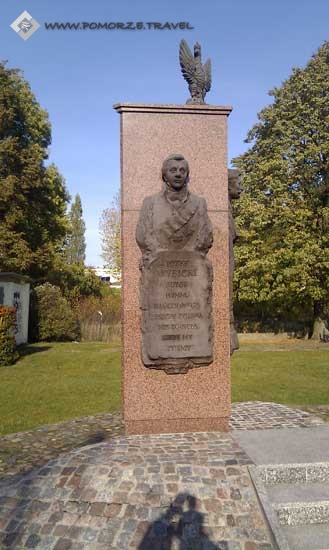
Wybicki Joseph was born 1747 at Bedomin near Kościerzyna in Pomerania, the son of an earthly judge and mother of Peter Wybicki Constance Lniska home. He had eight siblings.
Outstanding humanist of the Enlightenment, political activist, journalist, a respected speaker, writer, playwright and poet, confederate Barski, member of parliament, Supreme Court Justice, co-founder of the legions in exile in Lombardy, near Bologna.
He died of fever March 10, 1822 year in his estate near Manieczki Srem in Wielkopolska. He was buried in the churchyard in Brodnica, and the dust in 1923 have been transferred to Poznan and buried in the crypt of the church of St. Adalbert. In this church, he also married his beloved, about 17 years older, his wife Cunegonde Drwęską Gozdawa coat.
Known for writing the words of the soldier's song of the Polish Legions in Italy to the folk melody "old" mazurka Podlasie. The song was sung in person in Reggio nell 'Emilia July 21, 1797, during the farewell ceremony of General Henryk Dabrowski who pretends to be a meeting with Napoleon Bonaparte in Milan. The canticle of the time have been stepped remake adapting words to contemporary historical events. Initially it was a military song, then national, performed the ceremony of the national. From the battle of Grochow in February in 1831 began to treat it as a hymn called "Dabrowski's Mazurka". In 1926 the song was officially recognized as the Polish national anthem, "Poland has not perished."
The mansion where he was born Wybicki, in 1962 opened the Chamber of Remembrance of Joseph Wybicki, converted in 1978 at the Museum of the National Anthem as a branch of the National Museum in Gdansk. It is the only museum of its kind in the world.