Maritime Station in Gdynia
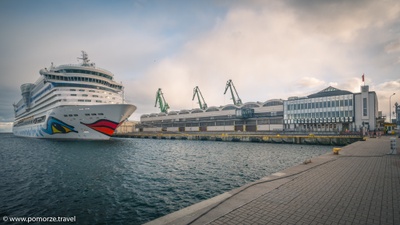
The Maritime Station building was designed by the Berlin branch of the Dyckerhoff & Widmann company in 1932. The facility was put into use on December 8, 1933, and the ceremonial consecration was performed by Bishop Okoniewski. The opening ceremony was attended by, among others, Minister of Industry and Trade Ferdynand Zarzycki, Ministers Józef Beck, Emil Kaliński, Bronisław Nakoniecznikow-Klukowski, Władysław Marian Zawadzki, Kazimierz Papée, and General Gustaw Orlicz-Dreszer. The Maritime Station served as the base for the passenger fleet "G-A-L," operating on routes to New York and South America. It had an area of 2.5 thousand square meters and was equipped with all the necessary facilities for passenger reception and clearance. The representative hall with ceremonial stairs was located at the front, and the departure lounge was on the first floor. One of the innovative solutions was the connection of passengers via gangways directly to the departure lounge on the ship moored at the quay. During the interwar period, Sunday services for port workers and the Main Maritime Office in Gdynia, as well as New Year's Eve balls, took place at the station. During World War II, the station was adapted for office purposes. After the German forces occupied Gdynia, the front elevation was stripped of Polish symbols. Due to Allied bombings of the port, part of the passenger hall was damaged, but it was temporarily repaired due to difficulties in reconstructing the original building structure. After the war, various institutions, such as the Port Captaincy and the postal-telegraphic office, were housed in the building. Passenger traffic resumed in the second half of the 1950s. In the 1970s, alongside passenger services, various port institutions operated in the building, such as the Navigation Services Department of the Gdynia Port Authority, Customs Office, and the Postal-Telecommunication Office Gdynia 18. Since the end of transatlantic shipping by Polish shipping companies in 1987, the Maritime Station ceased to fulfill its original function and was transformed into an office building for port companies and institutions. In 2005, the SEBTrans-Link project was initiated, including the concept of revitalizing the Maritime Station. Currently, cruise ships increasingly use the quays on both sides of the Maritime Station as mooring locations in the port.