Manor in Gradkowice
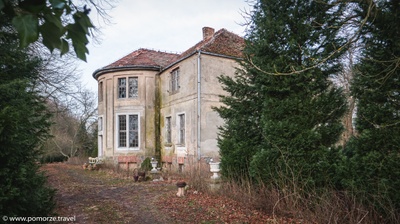
The name "gard" translated from Old Prussian means "fortress". Over the centuries, this estate passed through the hands of many Pomeranian families, such as von Mach, von Krockow, Wejherowie, and Chmielińscy. Since 1859, it has been owned by the von Koss family. Theodor von Koss carried out the reconstruction and expansion of the local palace, established a park, and dug two ponds. Erlich von Koss continued the modernization and enlargement of the estate and farm buildings. Unfortunately, Karl von Koss proved to be an irresponsible man and nearly squandered the family estate. Fortunately, Erlich's mother and widow, Elizabeth von Koss, managed to prevent this. In 1945, when news of the approaching Soviet army emerged, Elizabeth, along with her family (two granddaughters and a daughter-in-law), committed mass suicide by taking poison. Karl, who returned from hunting and found his dead family, also decided to commit suicide. The only survivor of the family was Elizabeth's grandson, who moved to Germany in the 1950s. The Soviets, upon occupying the palace, thoroughly looted it. During the Polish People's Republic era, the building served as a potato warehouse for the local state-owned farm. It gradually deteriorated, and during this time, the structure was 80% destroyed. In 1980, Count Jakub Smólski, with the support of Professor Wiktor Zinn, bought the entire estate. The new owner saved it from ruin by conducting renovation and interior renewal. At the site of the former icehouse, where the remains of the von Koss family members were accidentally discovered, the count erected an obelisk commemorating the tragically deceased predecessors. The current building, dating back to the early 20th century, includes a two-story manor with a front porch and a semi-oval projection on the garden facade, outbuildings, farm buildings, and a small walled park.
Associated with the manor is a legend that the palace is guarded by the spirit of Erlich von Koss, who often walks the creaking stairs. There is also a certain painting in the palace - a portrait of a Mauritanian prince, covered in a cloak whose sleeves are adorned with small bells. According to this legend, when someone is to die in the palace, the bells start ringing.