Manor and Park in Cewice
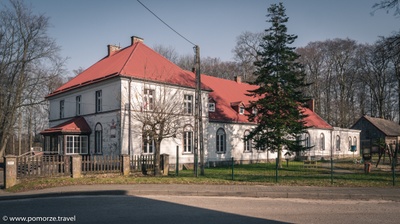
From the Middle Ages until 1760, the Cewice estates were in the hands of the Grell family, after which they often changed owners. The remnants of their residence include an old park established in the early 18th century. Around 1880, one of the owners, pharmacist Dempcke, erected a new manor in the park, which was expanded in the second decade of the 20th century by entrepreneur Sinner. During the last war, the manor served as a temporary SS prison. Currently, for many years, it has been serving as a school.
The manor has a neoclassical character and is located on the eastern edge of the village, with the entrance from the north. Built of brick on a stone pedestal, covered with plaster with characteristic rustication, imitating stone cuts. The entrance from the north is preceded by a masonry porch. The central part of the building is adorned with a two-axis projection, which originally was located on both sides of it. The building consists of three segments, with a small, one-story wing on the north, covered with a hipped roof. The central segment has one floor and is covered by a high hipped roof, and it is closed from the east by a single-story annex in the shape of the letter L, covered with a flat roof.
Near the manor, there is a spacious park divided into two parts: a forested one to the south and a landscaped one to the northeast. The manor stands at the southern edge of the park. Behind it stretches an extensive clearing bordered by old spruce trees, and on the nearby lawn, majestic Canadian firs grow. The park also contains 25 common beech trees estimated to be 180-220 years old, as well as other notable trees, mainly small-leaved linden trees. Among them rises an obelisk commemorating the Wejherowo prelate Edmund Roszczynialski, who in 1939 was tortured by the SS in the palace and then shot in the Cewice park.