History of the Church in Krokowa
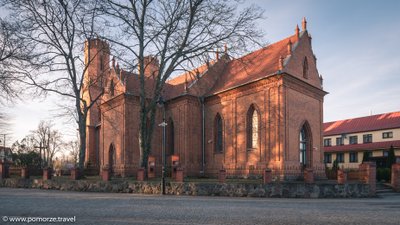
The church in Krokowa is a unique historical monument whose history dates back to the 14th century. The first wooden chapel was built around 1300 at the initiative of Piotr Krockow. In 1498, Wawrzyniec Krockow replaced it with a brick church with a wooden tower. In the 16th century, in 1572, the temple passed into the hands of Protestants and for the next few centuries served various religious communities, including Calvinists and members of the Prussian Union Church.
The current, Neo-Gothic church was built between 1833 and 1850 according to the design of Karol Gustaw Adolf von Krockow, modeled on the Rotterdam Cathedral. Built on a cruciform plan, it is distinguished by two 11-meter-high towers and a brick structure on a stone foundation. Until 1945, it was an Evangelical church dedicated to the Holy Cross. After World War II, in 1946, it was transformed into a Catholic church dedicated to Saint Catherine of Alexandria.
The interior of the temple is maintained in the Neo-Gothic style. Among the furnishings are a brick altar, a baptismal font, a pulpit, a music gallery, and a Baroque processional crucifix. In the basement of the church is the crypt of the von Krockow family, and above it is a rectangular annex of the former mausoleum. Although the crypt is not open to the public, it still reminds us of the close ties of the Krockow family to the history of the temple.
The church is located in the center of the village, at the intersection of the main communication routes. It is surrounded by an iron fence with brick pillars, moved in the 1960s from the local cemetery. It is worth paying attention to its carefully crafted brick facades and architectural details, which testify to the rich building tradition of this place.
The church in Krokowa is an important monument of Pomerania, combining history, culture, and architecture. It brings the history of the region closer and encourages people to learn about its past.