History and Architecture of the Church of St. Anthony of Padua in Osice
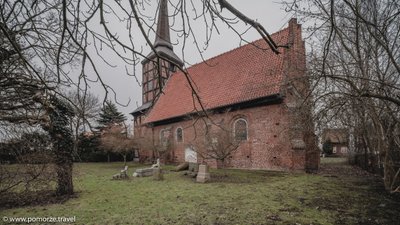
The branch church of St. Anthony of Padua in Osice is a unique example of sacred architecture with a long and rich history. Its origins date back to the 14th century, when a building was erected in a timber frame construction, on a rectangular plan, with a flat wooden ceiling. At the turn of the 14th and 15th centuries, the original timber walls were replaced with masonry, which ensured greater durability and stability of the structure. In the second half of the 15th century, the eastern gable was built, decorated with blind arches and pinnacles. In 1767, the church was extended to the north and a tall tower was erected on the western side. The tower, quadrangular, half-timbered, filled with brick and covered with plaster, narrows in the middle with a setback and ends in a slender helmet with a ball and weather vane. The base of the tower serves as a porch, and a sacristy, whose construction dates back to the 19th century, was added to the north wall. The church wall, reinforced with buttresses, emphasizes its solidity. During the Reformation, the church passed into the hands of the Evangelicals and served them until 1945. The building underwent several renovations, including in 1933 and in the second half of the 20th century, which allowed it to preserve its unique character. The interior of the church houses unique equipment from the 16th-18th centuries, which has survived almost unchanged. Of particular note are the Baroque music gallery with an organ loft and the original stalls, characteristic of the Żuławy neighbors.