Castle Mill in Słupsk
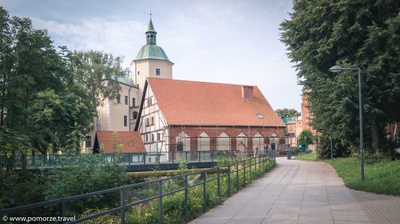
The Castle Mill is one of the oldest examples of industrial architecture in Poland. It was built around 1310 in the left-bank part of Słupsk, on land owned by the prince, even before the construction of the castle. The mill was powered by a waterwheel installed on a canal diverted from the Słupia River. The building's large volume and the small, narrow windows in the lower sections of the Gothic walls suggest that it also functioned as a granary. In the second half of the 16th century, during the expansion of the ducal castle, significant alterations were made to the mill's appearance. The Gothic granary windows were bricked up, and all the walls were refaced to give the building a Renaissance look. The northern facade was adorned with arcades supported by flat pilasters, and a wide portal was created in the central arcade. Further renovations took place in the 19th and 20th centuries. Around 1880, a new timber-framed eastern wall was erected, an annex was added, and partition walls were built inside when the western part of the mill was converted into a Veterans' Home. After 1925, the waterwheel was replaced with a turbine, housed in a separate building adjacent to the mill. In 1965, the Castle Mill was taken over by the Museum of Central Pomerania and became the seat of the museum's Ethnographic Department.